
When you see 3-5 inch raised ridges running across the surface of your lawn, accompanied by small volcanoes of soil here and there, you have a mole around. These small mammals can cause damage quickly because their tunneling ruins any plants in their path. As they dig through the earth, they destroy roots, so the tell-tale ridges of their tunnels rapidly turn brown. On the positive side, moles aerate the soil and eat destructive insects while they’re at it. Learn how to get rid of moles in your yard before they do extensive damage and keep them away.
What Are Moles?
Moles are burrowing insectivores. Except for breeding season in early spring, moles tend to live alone, so the multi-tunneled pattern in your yard is likely home to only one mole.
Moles build new feeding tunnels constantly and may not use the same one twice. You may find entry and exit mounds, usually round and symmetrical, pushed up volcano-fashion by the mole. The hole usually has soil in it but remains visible. The mounds are connected to main runways. The runways are 12-18 inches underground and not typically visible.
Moles feed on insects and insect larvae, but they’re especially fond of white grubs, a common lawn pest. Given a choice, moles pick moist, sandy loam soils over dry, heavy clay soils. They are most active during warm, wet months, although they live underground year-round.
How to Identify Moles
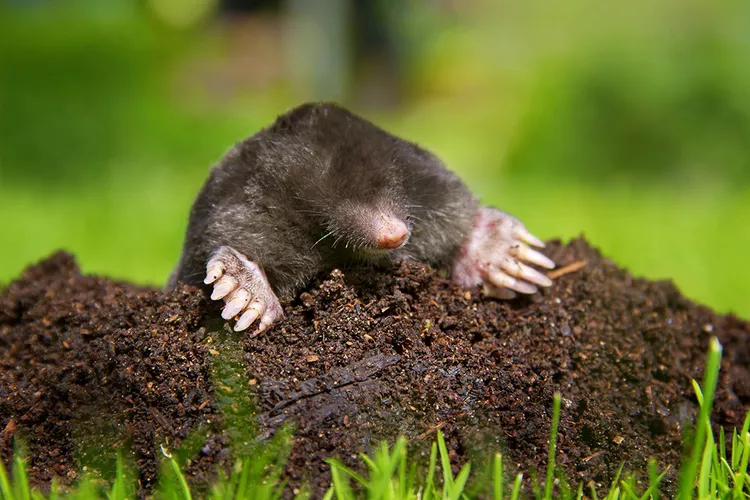
Moles have black or gray fur and a prominent, hairless snout. Their eyes are very small and buried in fur that they are almost invisible. Their front claws are large and hairless, designed for digging. Their ears are not visible.
Difference Between Moles, Voles, and Pocket Gophers
Homeowners sometimes mistake mole tunnels for those made by voles or pocket gophers, small rodents that also tunnel underground. Whereas moles leave prominent ridges above their tunnels in your lawn, capped off with distinctive volcano-shaped soil mounds, voles leave only subtle evidence of their tunnels in the landscape, if any. Their tunnels soften the soil, though, so it feels soft when you walk on it, and the small, flat, circular entrance holes to their tunnels are much more subtle than those of moles.
Pocket gophers don’t create prominent raised ridges as they go. Instead, they eat the roots of grass and other plants, pulling them down into underground burrows, which tends to push soil out to the side. Their tunnels look more flattened than mole tunnels, with fan-shaped or semicircular mounds. Each mound may contain a visible hole, although earth clumps can camouflage the hole.
If you happen to see one of these creatures, you might be able to identify it by size. At 4–7 inches long, a mole is smaller than a pocket gopher but larger than a vole.
How to Get Rid of Moles
Spring and fall, when the ground is not frozen, are the best times of the year for getting rid of moles because that’s when they’re most active. You likely have only one or two moles to trap to solve the problem because they don’t live in groups.
Humane Solutions
Remove the food source. The most humane way to get rid of moles is to use beneficial nematodes that dine on the grubs that form much of the mole diet. Without their favorite food source, moles tend to move on. This organic pesticide can be used safely around children and pets.
Put out a live trap. You’ll need to find an active tunnel for the trap. To identify an active tunnel, flatten it by stepping on it and checking it the next day to see if it is no longer flat, meaning a mole has passed that way. Install the live trap. following the product directions. Check the trap daily, or the animal might die while confined. Take it far away from your yard and release it.
Use a repellant. A safe liquid repellent frequently contains castor oil, which disturbs the natural eating patterns of moles, causing them to leave the area. Granular repellant with castor oil works the same way.
Not all repellants are child- and pet-safe. Confirm a repellent or deterrent is safe to be around your family and animals before buying it.
Lethal Solutions
Figuring out how to get rid of moles can be tricky because they live underground. Poisons and fumigants are options but should be avoided if you have pets or children that may be exposed.
The only sure way to eliminate a mole is to use a mole-specific trap that kills the animal. You can find below- and above-ground traps in several designs to do the job. Follow the package directions for correct placement, and move the tunnel traps daily while you still notice activity to increase your chances of eliminating the mole.
How to Keep Moles Away
After you get rid of moles, use one or more of these methods to keep them away.
Plant flowers moles hate: Moles dislike the scents of marigolds, daffodils, and alliums, so planting these in a garden bed discourages moles while providing a colorful addition to your yard.
Go techy with ultrasound: Install ultrasonic mole-repellent devices. These devices emit an ultrasound that drives moles away without any chemicals. They are low-maintenance (some are solar-powered) and safe to use around people and pets.
Spread a deterrent: Make your yard inhospitable by sprinkling a child- and pet-safe granular deterrent around the yard.
Improve yard drainage: Because moles prefer to live in areas where the soil stays moist, improving the drainage on your property might discourage them.
Use barriers: If you frequently have moles around and don’t mind a few tunnels around your property, try the barrier method to protect small spaces, like a veggie garden or a colorful flower bed in your front yard. Create an underground fence by burying a 24-inch metal or hardware cloth barrier at least a foot below the surface. If a mole tunnels into this barrier, it usually moves on and digs elsewhere.