
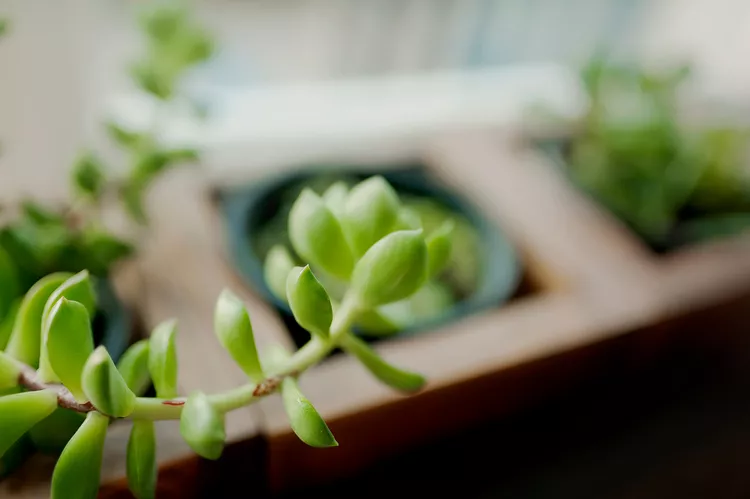
Succulents are popular, low-maintenance houseplants that crave bright light. The plants can develop unsightly, spindly stems in low-light homes. Whether you keep jades, echeveria, sedums, or other succulent species, this guide will explain how to fix leggy succulents, repair crooked stems, and grow more baby succulents for your houseplant collection.
What Are Leggy Succulents?
Most common succulents are light-hungry plants that need at least six hours of bright light daily to grow well. Indoors, succulents typically do best in sunny, south-facing windows, although some more sensitive succulents prefer bright, indirect light. However, one thing most succulents won’t tolerate is low light.
Succulents require light to grow and photosynthesize, and they will strain and stretch toward the light if they aren’t getting enough sun. While this stretching can be difficult to detect at first, if it goes unchecked for long, you’ll end up with succulents with leggy “etiolated” growth, shabby and discolored leaves, and crooked stalks. With a bit of care, leggy growth can be corrected.
How to Prevent Leggy Succulents
While it is possible to fix stretched succulents, it’s much easier to prevent leggy growth. All you need to do is provide your plants with lots of light. Most succulents do well in brightly lit windows that get six to eight hours of light daily. However, if your home doesn’t receive much natural light, keep succulents under an LED grow light and leave the light on for 12 to 14 hours a day.
Turning succulent pots every week or two can counteract bending stems by providing equal light to all sides of the plant. When light levels are lower during winter, move plants closer to windows or add a grow light.
How to Fix Leggy Succulents
Once succulents are leggy, there’s no quick cure—but there are ways to improve the look and growth of stretched plants with a little time and patience. If you catch leggy growth early, you can prevent stems from getting longer by boosting light levels. This won’t fix the damage that’s already done, but it will help plants grow better in the future. Gradually increase light exposure over the course of several days or weeks. Too much bright sun all at once can cause sunburnt leaves.
Although mild stretching can be remedied with bright light, severely stretched succulents require a more aggressive solution: Propagation.
How to Propagate Succulents
It can be intimidating to snip off succulent stems, but it’s the best way to repair leggy growth and revert succulents to their more colorful and compact forms. Use these tips to propagate different sections of leggy succulents into new succulent plants.
Repair the Rooted Section
Using a sharp and sterilized knife, cut the succulent stem at the point on the stem where it begins to get leggy, making sure the lower portion of the stem has at least two or three leaves and at least 1 to 2 inches of stem remains above the soil line. Don’t throw out the upper portion of the plant that you just removed—you can propagate it.
After removing the leggy top section, move the remaining, rooted lower portion of the succulent into bright, indirect light and care for it as usual. In a few weeks, the stem should start to sprout leaves and regrow into a more compact plant as long as it receives plenty of light.
Propagate the Upper Section
The top portion of the leggy succulent you removed can also be propagated into new plants. If the stem is very long, cut it down to a manageable size; the cutting you keep should be at least 2 inches long and have at least two leaves. If the stem is very overgrown, you may be able to cut it into several smaller sections and propagate each section into a new plant.
After cutting the succulent stem to a manageable size, gently remove the lower leaves on the stem to make it easier to plant. Save those leaves—you can often propagate new plants from succulent leaves, too.
Place the succulent stem on a plate for a few days to allow the cut end to callus over, and then plant the cut stem in a pot filled with a moist potting mix designed for cacti and succulents. Move the plant pot to a location that receives bright, indirect light, and water it when the soil feels dry. After the succulent stem roots, reduce watering, increase light, and care for your new succulent as you care for the parent plant.
Propagating Extra Leaves
Almost all sections of a leggy succulent can be propagated, including the extra leaves you removed from the stems. Place the leaves in a single layer on a plate. Move the plate to a warm, dry spot out of direct sunlight for a few days so the leaves can callus over. Then, fill a pot with a moist, succulent or cactus potting mix, and position the leaves on the substrate so they aren’t touching each other. Move the leaves into bright, indirect light.
Any leaves intended for propagation should be peeled (not cut) from the plant. Torn, damaged, or broken leaves don’t root well.
Within a few weeks, succulent leaves should start to produce new growth. During this time, water lightly when the top ¼ inch of soil feels dry, and then pot the succulents in individual pots when they’re a few inches tall.