
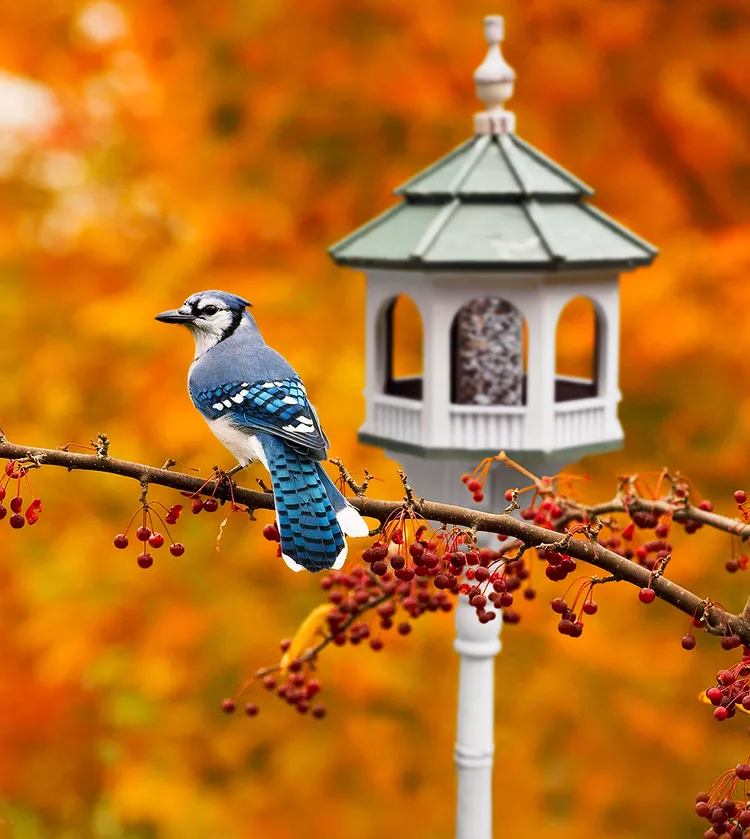
Invite flocks to your backyard by including berry plants for birds in your landscape. These fruit-bearing trees and shrubs do double duty: They attract berry-eating birds such as bluebirds and robins while also creating a beautiful display with their flowers, fall colors, and fruits.
American Cranberry Viburnum
American cranberry bush viburnum (Viburnum opulus var. americanum) is a beautiful flowering shrub that has white springtime flowers, maple-shaped leaves that turn bright colors in autumn, and red fall berries. Brown thrashers, cedar waxwings, and other birds feast on long-lasting fruits, which can provide a source of food even in winter.
Growing Conditions: Full sun to part sun and well-drained soil
Size: Up to 12 feet tall
Zones: 2-7
Red-Twig Dogwood
A standout in winter because of its bold red stems, red-twig dogwood (Cornus sericea) also features clusters of small white flowers in spring, white fruits in summer and fall, and a bold red-orange autumn color.
Growing Conditions: Full sun to part sun and moist, well-drained soil
Size: Up to 8 feet tall
Zones: 2-8
Chokeberry
Brown thrashers are fond of chokeberries (Aronia arbutifolia) and so are cedar waxwings and other songbirds. It spreads by suckering and is a good choice for a hedge. The chokeberry shrub is also native to many parts of the country, so it's especially good for supporting local wildlife.
Growing Conditions: Full sun to part shade and well-drained soil
Size: Up to 10 feet tall
Zones: 4-9
Wahoo
A North American native counterpart to burning bush, wahoo (Euonymus atropurpureus) likes a moist, sunny spot. It produces bright scarlet berries in autumn and has a red fall color that makes for an attractive informal hedge.
Growing Conditions: Full sun to part shade and moist, well-drained soil
Size: Up to 20 feet tall
Zones: 3-7
Eastern Red Cedar
Eastern red cedar (Juniperus virginiana) is an evergreen North American native tree that can provide shelter to birds among its dense branches. Female plants offer blue berrylike cones that many species of birds eat.
Growing Conditions: Full sun and well-drained soil
Size: Up to 65 feet tall
Zones: 3-9
Staghorn Sumac
A fast-growing, quick-spreading shrub native to parts of North America, staghorn sumac (Rhus typhina) offers ferny leaves that turn bold red in fall. It also features clusters of furry dark red fruit that hold on through the winter, supplying a variety of birds including robins and vireos.
Staghorn sumac may be too aggressive of a spreader for most gardens. Be sure to plant it in a spot where it can create a thicket.
Growing Conditions: Full sun to part sun and well-drained soil
Size: Up to 15 feet tall
Zones: 3-8
Winterberry
Often unnoticed in the summer garden, winterberry (Ilex verticillata) stops traffic when the leaves drop in autumn and the berries ripen. Branches covered with bright red fruit attract mockingbirds, robins, and other birds. This North American native holly needs a pollinator to produce berries, so make sure you have both a male and female plant.
Growing Conditions: Full sun to part sun and well-drained soil
Size: Up to 15 feet tall
Zones: 3-9
Crabapple
Most gardeners grow crabapples (Malus selections) for the ornamental value of their spring blooms. The fruits, however, are the apples of birds' eyes. To attract the greatest variety of songbirds, select cultivars with small fruits that hang on through the winter.
Growing Conditions: Full sun and moist, well-drained soil
Size: Up to 40 feet tall, depending on variety
Zones: 4-8
Highbush Blueberry
Gray catbirds like to nest in highbush blueberry (Vaccinum corymbosum). This native shrub also produces sweet berries that both you and bluebirds, robins, and many other birds will enjoy. And it lights up the landscape with its bright red-orange fall color, too.
Growing Conditions: Full sun and well-drained, acidic soil
Size: Up to 12 feet tall
Zones: 3-9
Beautyberry
Showy clusters of purple fruit make beautyberry (Callicarpa dichotoma) attractive to both birds and flower arrangers. The arching wands of berries last a long time in the garden or a vase and provide nutrition and moisture for birds in winter. Beautyberry thrives in light shade but produces more berries in a sunny spot.
Growing Conditions: Full sun to part shade and moist, well-drained soil
Size: Up to 4 feet tall
Zones: 6-8
Serviceberry
Robins, thrushes, and other birds are quick to eat the fruits of serviceberry (Amelanchier selections), which you can also eat if you can get any before your avian friends do. This plant grows as a small tree or large shrub, depending on the variety. They range from 4 to 25 feet tall, but all offer pretty springtime blooms and eye-catching fall colors. Most are native to North America.
Growing Conditions: Full sun to part shade and well-drained soil
Size: Up to 25 feet tall, depending on variety
Zones: 4-9
Bunchberry
A low-growing shrubby native plant, bunchberry (Cornus canadensis) has leaves, flowers, and berries that look remarkably like those of its cousin, flowering dogwood. The white flowers sparkle in a woodland garden in spring; the berries turn red in autumn and are a favorite of vireos.
Growing Conditions: Full shade to part sun and moist, well-drained, acidic soil
Size: Up to 6 inches tall
Zones: 2-7
Arrowwood Viburnum
A particularly good shelter plant for birds, arrowwood (Viburnum dentatum) is a very hardy and adaptable shrub. It features pretty, creamy white flower clusters in early summer. In late summer and autumn, bunches of blue-black berries appear. Plant near other viburnums to ensure good pollination.
Growing Conditions: Full sun to part shade and well-drained soil
Size: Up to 12 feet tall
Zones: 3-8
Pagoda Dogwood
Downy woodpeckers, brown thrashers, eastern bluebirds, and many other backyard birds are attracted to the dark fruits of North American native pagoda dogwood (Cornus alternifolia). This small tree is best suited for the edges of woodland areas or shady gardens. Pagoda dogwood has a striking horizontal branching habit. Creamy white flower clusters appear above the leaves in spring.
Growing Conditions: Full to part shade and well-drained soil
Size: Up to 12 feet tall
Zones: 4-8
Nannyberry
A native shrub or small tree, nannyberry (Viburnum lentago) has glossy, dark green leaves and drooping clusters of berries in early fall. Nannyberry can be pruned to form a hedge or grown at the back of a border. The berries ripen to blue-black and last well into winter to feed birds.
Growing Conditions: Full sun to part shade and well-drained soil
Size: Up to 10 feet tall
Zones: 2-8
American Elderberry
Native to North America, elderberry (Sambucus canadensis) thickets give excellent shelter and are favored nesting sites for many species of birds. This fast-growing shrub produces enormous, creamy flower clusters the size of dinner plates in summer, followed by purple berries in fall that birds relish.
Growing Conditions: Full sun to part sun and moist, well-drained soil
Size: Up to 12 feet tall
Zones: 4-9
Cranberry Cotoneaster
Cranberry cotoneaster (Cotoneaster apiculatus) is a low, arching, and mounding shrub with glossy leaves and red fruits. Good for slope, terrace, or foundation planting, most varieties deliver bountiful red berries in autumn that persist into the winter. You can choose from compact, upright shrubs to easy groundcovers to big plants ideal for hedges.
Growing Conditions: Full sun to part sun and well-drained soil
Size: Up to 3 feet tall
Zones: 4-7
Firethorn
The dense, thorny branches of this semi-evergreen to evergreen shrub provide good shelter and nesting places as well as berries. A dense covering of red-orange berries covers firethorn's (Pyrancantha coccinea) branches in autumn, adding beautiful fall color to your garden. The berries are preceded by white flowers in summer.
Growing Conditions: Full sun to part sun and well-drained soil
Size: Up to 16 feet tall
Zones: 7-9
Rose
Rose hips (the fruit of roses) vary in size and color, but all prove delectable to birds and other wildlife. There are heirloom roses, climbing roses, groundcover roses, English tea roses, and more, and all have the ability to produce rose hips. The most common type of rose used to produce rose hips is Rosa canina.
Growing Conditions: Full sun and moist, well-drained soil
Size: Up to 6 feet tall, depending on variety
Zones: 4-11